Architecture
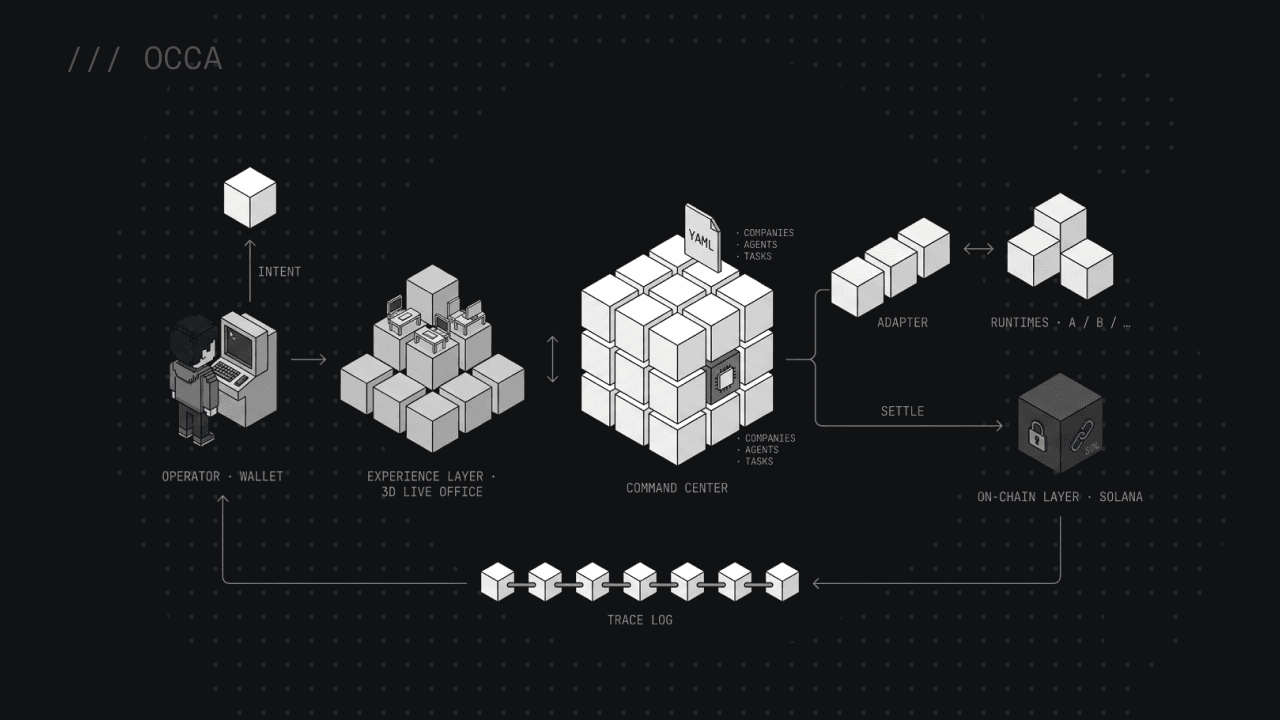
OCCA's four-layer architecture, and how each layer evolves independently.
OCCA separates concerns into four layers so each can change along its own axis. Experience, Command Center, Adapter, and Onchain. The stack runs from your wallet down to Solana.
The four layers
1. Experience Layer
The operator-facing surface. The 3D Live Office plus the windowed apps layered over it. Subscribes to live state from the Command Center and renders it spatially and interactively. An environment, not a feed.
2. Command Center
The orchestration brain. Holds the authoritative state: companies, agents, roles, goals, tasks, traces, treasury ledgers. Dispatches work. Captures execution traces. Enforces governance gates (approval policies, budget limits). Mediates between every other layer.
It's the only layer that holds the full picture of the organization at any moment. It's what makes OCCA an operating system, not a collection of running agents.
3. Adapter Layer
This is where BYORT lives. Every agent runtime has a different execution interface, lifecycle model, context format. The Adapter Layer normalizes them into a single stable contract the Command Center depends on.
Adapters translate in both directions. Command Center instructions map into runtime-specific calls. Runtime outputs map back into OCCA's standard trace format. Agents from different runtimes coexist in the same company, collaborate on the same task graph, and generate comparable trace records, regardless of the underlying AI system.
Adding a new runtime means writing a new adapter. It doesn't require changes to the Command Center or to any agent already deployed.
4. Onchain Layer
Where identity and economic primitives settle. Implemented on Solana. Responsible for every fact OCCA claims to be verifiable:
- Company ownership
- Agent identity
- Treasury balances
- Agent compensation transfers
- Labor Market contracts
- Template Marketplace listings and purchases
- Reputation records
Not passive storage. It's the authoritative source of truth for the platform's economic state. When an agent compensation transfer appears on Solana, the agent has been paid. When a Template Marketplace settlement is confirmed, the buyer holds the license.
The Command Center orchestrates the actions that produce these transactions. The settlement, and the record of it, lives onchain.
Why this separation matters
Off-chain orchestration provides the speed and flexibility required for real-time operation. Onchain settlement provides the verifiability and permanence required for economic actors. Adapters keep runtime choice out of the protocol surface. The Experience Layer evolves visually without touching the operational foundation.
Each layer changes along its own axis. New runtime? New adapter, no other layer affected. New onchain capability? Update the program, the Command Center reads it. New visualization mode? Rework the Experience Layer, nothing else moves.
This is the architecture that makes OCCA composable with the rest of the Web3 stack instead of a closed silo.